9. Testing
Quality Assurance
Every repository that uses the enablement framework inherits the same test machinery: shell unit tests for the framework functions, Python unit tests for the Sync CLI, and a devcontainer integration test that runs on every Pull Request. This page describes what exists, how to run it, and — just as important — what each layer does and does not prove.
🧭 The test layers at a glance#
| Layer | Lives in | Runner | What it proves | Runs in CI |
|---|---|---|---|---|
| Shell unit tests | .devcontainer/test/unit/*.bats |
bats | Framework shell logic in isolation — no Docker, no Kubernetes | ✅ framework-tests.yaml |
| Sync CLI unit tests | sync/tests/test_*.py |
pytest | The repo-sync CLI: repos.yaml parsing, version maths, command behaviour |
❌ not wired to a workflow yet |
| Repo integration test | .devcontainer/test/integration.sh |
GitHub Actions + devcontainers/ci |
The devcontainer builds, boots, and the repo's own assertions hold | ✅ integration-tests.yaml (PR) |
| Framework integration suites | .devcontainer/test/integration_*.sh |
Shell, in a real container | Cluster engines, app exposure, Dynatrace deployment modes end to end | Scheduled by Orbital (see below) |
Check that your check could have failed
A test that cannot go red is not a test. Before trusting a green run, confirm the runner actually
collected tests — bats reporting no tests, or a script that prints a success banner with its
assertions commented out, both look exactly like success. Every count on this page comes with the
command that reproduces it, so you can re-derive it instead of trusting it.
🧩 Shell unit tests (BATS)#
Unit tests exercise the framework's shell functions in isolation — no cluster, no Dynatrace tenant, no Docker daemon required.
# On the host (bats must be installed)
cd .devcontainer && make test

# Inside the running container (installs bats if the image lacks it)
cd .devcontainer && make test-in-container

# Directly, with TAP output
bats .devcontainer/test/unit/ --tap
What is covered#
| File | Area |
|---|---|
test_env_management.bats |
.env handling, variablesNeeded, environment parsing/export |
test_dynakube.bats |
Dynakube manifest generation and mode selection |
test_ingress.bats |
nginx ingress rules, magic-DNS hosts, app registry |
test_cluster_engine.bats |
CLUSTER_ENGINE routing between K3d and Kind |
test_source_framework.bats |
DEV vs CACHE mode, cache tiers, version pin resolution |
test_docker_group_access.bats |
Docker socket GID recovery |
test_greeting.bats |
Terminal greeting rendering |
test_token_config.bats |
Token format validation and migration status |
test_instantiation_type.bats |
INSTANTIATION_TYPE detection |
test_install_codespace_ssh.bats |
SSH install path guards |
test_framework_apps_guard.bats |
Framework-owned app guard |
Counting them is a one-liner — always prefer this to a number written in a document:
bats .devcontainer/test/unit/ --tap | grep -c '^ok'   # tests that passed
grep -rc '^@test' .devcontainer/test/unit/*.bats      # tests declared, per file
In CI#
.github/workflows/framework-tests.yaml installs bats on ubuntu-24.04 and runs the whole
directory with --tap. It triggers on push and pull request only when one of these paths
changes — plus a nightly cron and manual dispatch:
.devcontainer/util/**.devcontainer/test/unit/**.github/workflows/framework-tests.yaml
Path filters are part of the test
The workflow carries a scar comment explaining why: the filters once named functions.sh and
my_functions.sh — paths that exist nowhere in this repository, since the shell sources live
under .devcontainer/util/. Only the nightly cron ever fired, and a greeting.sh regression
merged green. If you move a shell source, move the filter with it.
🐍 Sync CLI unit tests (pytest)#
The Synchronizer has its own suite covering repos.yaml parsing, version
parsing/bumping, the GitHub API wrapper, local git operations, and each subcommand.
pip install -r requirements-dev.txt      # pytest, pytest-mock, pyyaml
pytest sync/tests                        # rootdir comes from sync/pyproject.toml
pytest sync/tests -q --collect-only | tail -1   # how many tests exist right now
The suite needs no network and no GitHub token — the GitHub API layer is mocked.
This suite has no CI job yet
Nothing in .github/workflows/ runs it. Verify for yourself rather than taking this page's word
for it — and note the positive control, which proves the search itself works:
grep -rn 'pytest\|sync/tests' .github/workflows/   # expected: no output
grep -rln 'bats' .github/workflows/                # positive control: hits framework-tests.yaml
sync/ or repos.yaml.
🧪 Integration testing on Pull Requests#
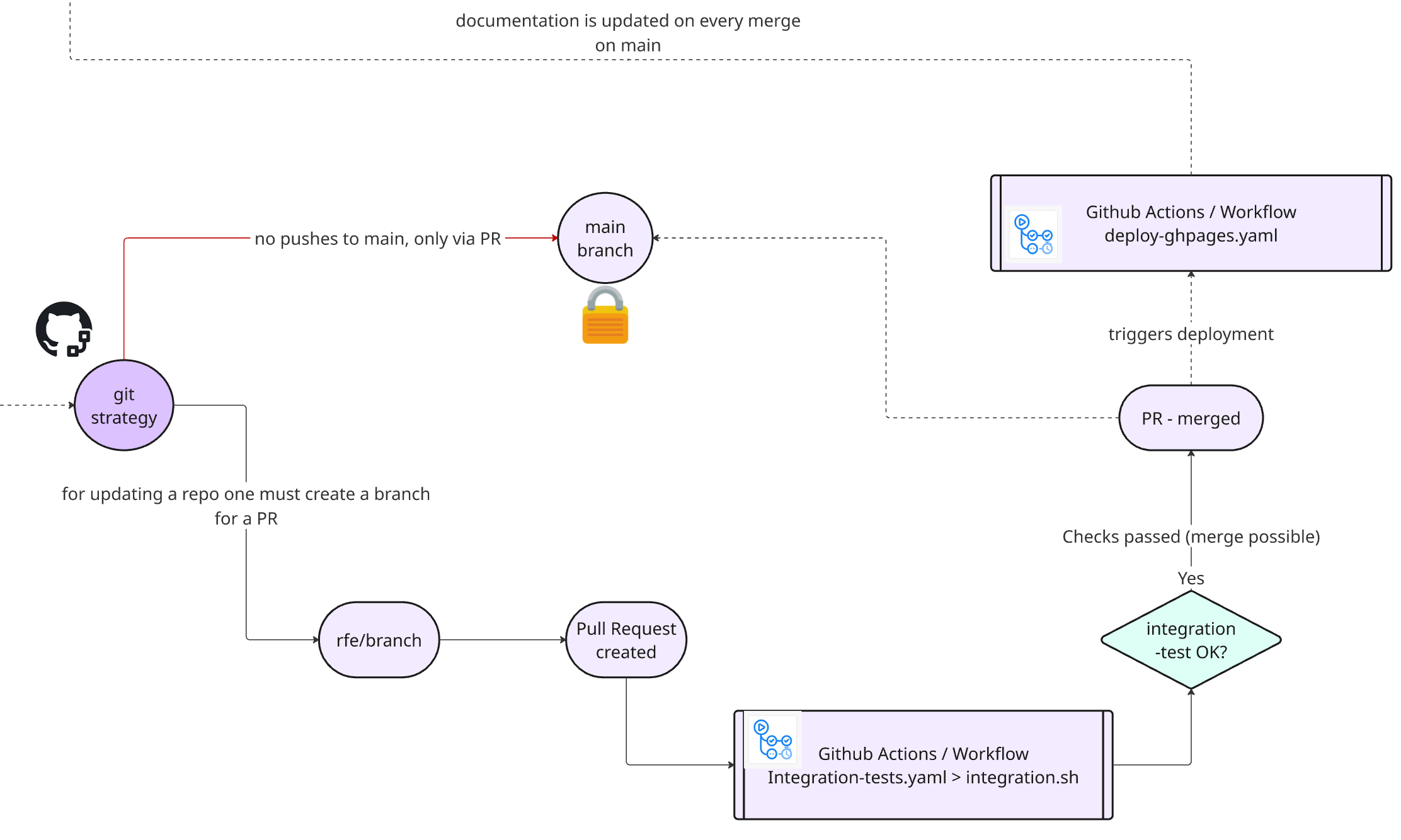
Every repository carries .devcontainer/test/integration.sh, adapted per repo, run by
.github/workflows/integration-tests.yaml on every PR targeting main. The workflow:
- Writes the Dynatrace secrets (
DT_ENVIRONMENT,DT_OPERATOR_TOKEN,DT_INGEST_TOKEN) into.devcontainer/.env - Rewrites
runArgsindevcontainer.jsonso the container receives that env file - Builds and boots the devcontainer with
devcontainers/ciagainst the enablement image - Runs
zsh .devcontainer/test/integration.shinside it - Fails the job — and blocks the PR — if the script exits non-zero. Timeout: 10 minutes.
Run the same thing locally:
Example: integration.sh#
A banner is not an assertion
An integration.sh that sources the framework, prints a heading and exits still proves something
real — the devcontainer builds and boots — and for a training with no running application
that may be the honest answer. But it can never go red, so say so out loud:
What must never happen is the third state: assertions commented out under a line that prints "Integration test passed". That is a green light wired to nothing. If an assertion is disabled, delete it or explain in a comment why it cannot run here.
Branch protection#
main is protected and requires the integration-test status check
(codespaces-integration-test-with-dynatrace-deployment, the job name in integration-tests.yaml)
to pass before a PR can merge. The Sync CLI applies the same rule across the fleet:
🔬 Test function reference#
Assertions live in .devcontainer/test/test_functions.sh, which functions.sh sources into every
shell session — so they are available in integration.sh, in my_functions.sh, and interactively.
Pod & container assertions#
| Function | Signature | Behaviour |
|---|---|---|
assertRunningPod |
assertRunningPod <namespace> <name-fragment> |
Verifies the namespace exists and at least one pod matching <name-fragment> is running. Exits 1 otherwise. Called with one argument it searches all namespaces. |
assertRunningContainer |
assertRunningContainer <name> |
Verifies a Docker container matching <name> is running (docker ps). |
assertRunningPod dynatrace operator        # DT operator pods in the dynatrace namespace
assertRunningPod kube-system coredns       # CoreDNS
assertRunningPod todoapp                   # one arg → all namespaces
assertRunningContainer my-sidecar
HTTP & application assertions#
| Function | Signature | Behaviour |
|---|---|---|
assertRunningApp |
assertRunningApp <app-name> |
Probes the app through nginx ingress using both the magic-DNS host (app.<ip>.sslip.io) and the hostname-based host, honouring K3D_LB_HTTP_PORT. Retries with spacing. |
assertRunningHttp |
assertRunningHttp <port> [path] |
Asserts an HTTP endpoint on localhost returns 200 OK. Retries with delay. |
assertAstroshopContent |
assertAstroshopContent |
Astroshop-specific: root path returns valid HTML, page contains shop keywords, at least one static asset loads. Call after assertRunningApp. |
assertRunningApp todoapp            # ingress-based check (K3d/Kind + sslip.io)
assertRunningHttp 8000 /            # direct port check (MkDocs, etc.)
assertRunningApp vs assertRunningHttp
assertRunningApp is the check to use — it validates that ingress routing works with magic DNS,
which is how learners reach the app in every instantiation type. Use assertRunningHttp only for
services published directly on a host port rather than through the ingress.
Ingress & deployment assertions#
| Function | Signature | Behaviour |
|---|---|---|
assertIngressRoute |
assertIngressRoute <app-name> [namespace] |
Verifies an Ingress named <app-name>-ingress exists and reports its host rule. Namespace defaults to the app name. |
assertAppDeployed |
assertAppDeployed <app-name> [namespace] |
Full stack check: assertRunningPod + assertIngressRoute. |
Environment assertions#
| Function | Signature | Behaviour |
|---|---|---|
assertEnvVariable |
assertEnvVariable <var-name> [pattern] |
Asserts the variable is set and, when given, matches the regex. Exits 1 when unset or non-matching. |
Placeholders that cannot fail — do not rely on them
Three functions in test_functions.sh are stubs. They print output but assert nothing and
can never exit non-zero:
| Function | What it actually does |
|---|---|
assertDynatraceOperator |
kubectl get all -n dynatrace, then prints TBD |
assertDynatraceCloudNative |
kubectl get all + kubectl get dynakube, then prints TBD |
assertDynakube |
empty body |
Calling them makes a test look thorough while proving nothing. Until they are implemented, use
assertRunningPod dynatrace operator, assertRunningPod dynatrace activegate and an explicit
kubectl get dynakube check instead.
🚀 Framework integration suites#
Beyond the per-repo test, the framework carries its own end-to-end suites. Each one creates a real cluster, deploys real components, asserts, and tears the cluster down. They run inside a container — on the Orbital ops platform, in a Codespace, or on a local machine.
| Suite script | Validates | Arch | Needs Dynatrace credentials |
|---|---|---|---|
integration_engines.sh |
nginx ingress app exposure is identical on K3d and Kind | Kind leg is AMD64-only and skipped on Sysbox | No |
integration_k3d_apps.sh |
Every demo app deploys on K3d and is reachable via ingress | AMD64 only | No |
integration_k3d_aitraveladvisor.sh |
AI Travel Advisor stack (Ollama, Weaviate, app) on K3d | AMD64 only (Ollama has no ARM64 image) | DT_LLM_TOKEN — skips gracefully when absent |
integration_appmon_k3d_todoapp.sh |
Dynatrace ApplicationMonitoring end to end on K3d | AMD64 and ARM64, run independently | DT_ENVIRONMENT, DT_OPERATOR_TOKEN, DT_INGEST_TOKEN |
integration_cnfs_k3d_todoapp.sh |
Dynatrace CloudNativeFullStack on K3d | AMD64 and ARM64 | same three |
integration_dtwiz_k3d.sh |
The dtwiz CLI path: install, status, analyze, install kubernetes |
any | DT_ENVIRONMENT + DT_PLATFORM_TOKEN (dt0s16), not the classic tokens — or the tenant's own OAuth client, from which the suite mints one for the run (see below) |
integration_kind_astroshop.sh |
Astroshop on Kind: ingress, HTML content, static assets | AMD64 only; skipped on Sysbox | No |
Credentials are never baked in: each suite reads them from .devcontainer/.env locally, or from
secrets injected per job by the platform that schedules it.
Why the arch matters#
The Dynatrace code module and CSI driver images differ per CPU architecture. Running appmon and
cnfs independently on AMD64 and ARM64 is what proves the correct image is pulled and injected on
each — a single-arch run cannot show that.
Running one locally#
# Requires .devcontainer/.env with the credentials the suite needs
bash .devcontainer/test/integration_appmon_k3d_todoapp.sh
bash .devcontainer/test/integration_cnfs_k3d_todoapp.sh
Platform tokens: supplied, or minted for the run#
integration_dtwiz_k3d.sh needs a gen3 platform token (dt0s16), and takes it one of two ways.
The order is the point:
DT_PLATFORM_TOKENis set — a provisioned training environment already holds one, minted by the enablement app with the tenant's own OAuth client before the container started. The suite uses it as given and mints nothing. This is the learner's path and the one the suite exists to exercise.- It is not set — then
DT_OAUTH_CLIENT_ID,DT_OAUTH_CLIENT_SECRETandDT_OAUTH_RESOURCE(the tenant's own OAuth client and its account URN) let the suite mint a short-lived token for this run, through the same Account Management API the app uses, and revoke it at teardown.
# On a machine that is not a provisioned training environment:
export DT_ENVIRONMENT=https://<tenant>
export DT_OAUTH_CLIENT_ID=... DT_OAUTH_CLIENT_SECRET=... DT_OAUTH_RESOURCE=urn:dtaccount:...
bash .devcontainer/test/integration_dtwiz_k3d.sh   # mints, runs, revokes
The minted token carries the scopes dtwiz itself documents — no more. A harness token wider than the learner's would hide the scope failure the suite is meant to catch, so if a mint is refused for want of a scope, that is a finding about what the tenant grants that client, not a scope to add.
Why not just store a platform token?
Because a stored one is long-lived, rotated by nobody, and says nothing about what the app
actually grants a learner. Minting per run keeps the credential short-lived and keeps the test
honest about the scopes under test. The helper lives in
.devcontainer/test/mint_platform_token.sh (+ .py) and is loaded by the suite, not by
post-create.sh — learners never run it.
Known limitation — OneAgent DaemonSet on K3d
K3d nodes are Docker containers. OneAgent's host init module needs real kernel interfaces
(/proc, /sys) that container nodes do not provide, so the DaemonSet sits in
CrashLoopBackOff. This is expected, and the CNFS suite passes despite it. On Sysbox there
is a further restriction on host-level syscalls.
Validated: operator running, ActiveGate running, dynakube carries the
cloudNativeFullStack: spec, todo-app deployed and reachable.
Not validated: OneAgent DaemonSet running state — that needs real VM nodes.
Scheduling and nightly runs#
These suites, and the per-repo integration.sh of every repository with status: active in
repos.yaml, are dispatched on a schedule by Orbital, the ops platform. Orbital was split out of
this repository into a private one (see Orbital — Ops Platform), and its
scheduling, queues, worker lanes and result storage are documented there, not here — that
documentation is not publicly reachable.
What is worth knowing from this side of the boundary:
- A nightly run exercises repositories that have had no PR, which is how regressions from upstream changes (a new operator release, a new K3d version, a rebuilt base image) surface.
- A signal that is red every night is not a signal. But "this environment holds no such credential"
is rarely the end of the story, and reading it that way once cost this suite its coverage:
integration_dtwiz_k3d.shwas written off as unrunnable anywhere without a standingDT_PLATFORM_TOKEN, and a standing platform token is precisely what a well-run environment does not keep. Platform tokens are minted, per training, by the enablement app from the tenant's own OAuth client — so the suite now mints its own the same way when no token is supplied, uses it, and revokes it at teardown. Before scoping a suite out, check whether the credential it wants is one the product creates on demand.
Git Strategy#
Git Strategy & GitHub Actions Workflow
🛡️ Integration test badges#
Every repository displays an integration-test badge, so the health of each repo is visible at a glance. For this repository:

The full table of framework repositories and their current status is in the README of this repository.
By keeping these layers separate — shell logic without a cluster, CLI logic without GitHub, and integration tests with the real thing — a failure points at where it came from, and a green run means something specific.